
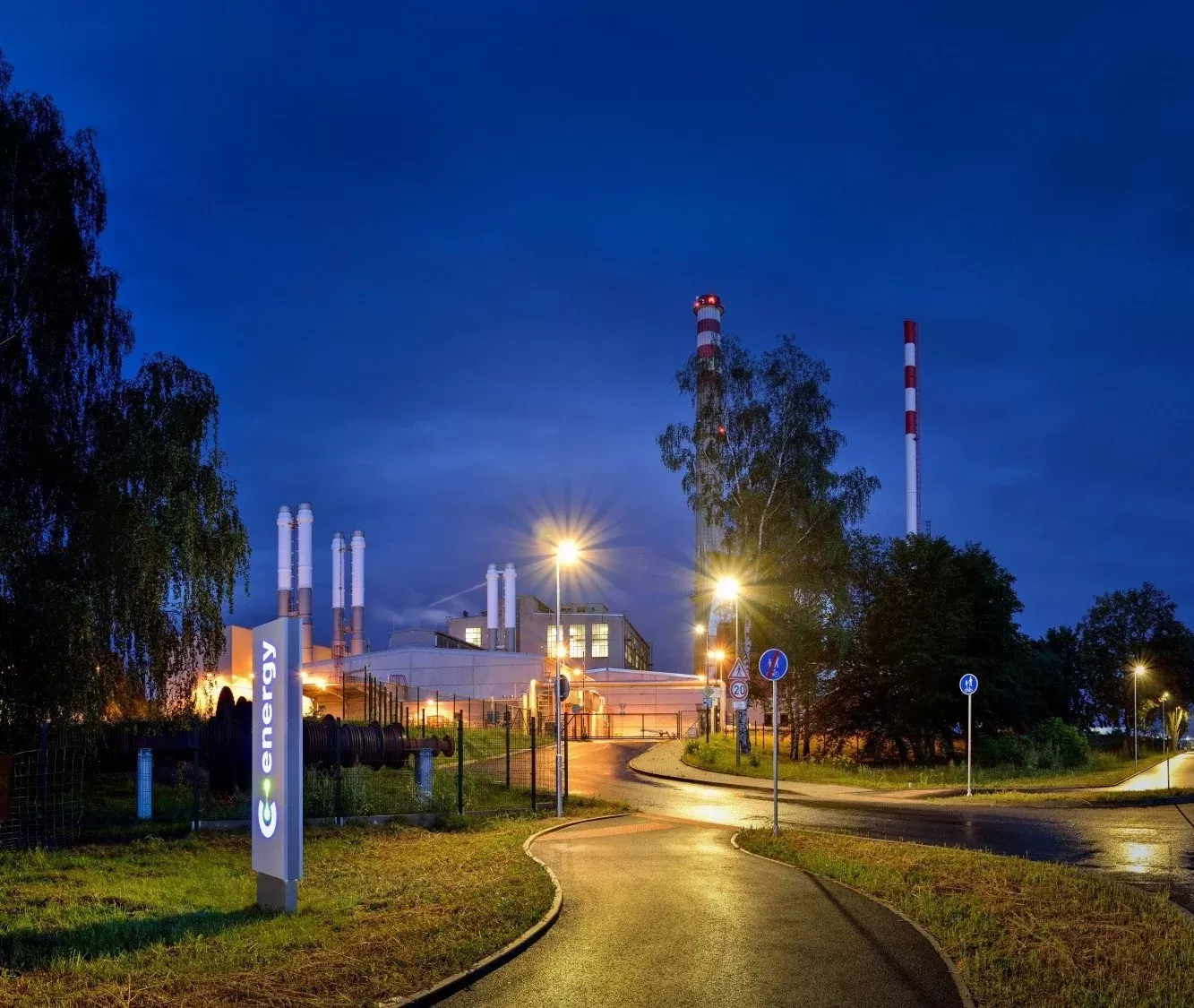
Planá nad Lužnicí, 16 February 2025 – C-energy continues the construction of a waste-to-energy (WtE) facility within the premises of its energy plant in Planá nad Lužnicí. The first phase, including site preparation and demolition works, was successfully completed at the beginning of this year. The commissioning of the facility is scheduled for 2027, and discussions with surrounding municipalities regarding waste processing are now gaining momentum.
Throughout the past year, activities primarily focused on dismantling and demolition works to prepare the site for the installation of new structures and technologies. Technically demanding earthworks were completed, along with the construction of underground reinforced concrete bunkers for waste storage in the future waste reception and treatment hall. A new hall will be built above the nearly completed bunkers during 2026, where waste reception and treatment from nearby municipalities will take place while the existing energy plant remains in full operation.
“We are progressing exactly according to the schedule agreed upon when signing the contract with the general contractor. The initial phase largely involved site preparation and works that may not be immediately visible but are crucial for the safe and reliable installation of new technologies. We are now gradually entering a phase where the construction will become more visible to the public,” said Jiří Morávek, Director of Development and Investments at C-energy.
While maintaining full operation of the energy plant, the complex demolition of an unused electrostatic precipitator building was also completed. In the second half of this year, installation of a state-of-the-art multi-stage flue gas cleaning technology for the new boiler will begin at this location, enabling operation in compliance with the most stringent environmental standards.
A Solution for Municipalities Ahead of the Landfilling Ban
In the coming months, negotiations with municipalities and other waste producers regarding future cooperation conditions will intensify.
“Our goal is to establish stable and long-term predictable conditions that will allow municipalities to gradually reduce landfilling of mixed municipal waste and prepare for the ban on landfilling recyclable and energy-recoverable waste from 2030. For municipalities in the surrounding area, these discussions are not new; we have been working together on preparations for this new waste-to-energy technology for several years,” added Jiří Morávek.
The new facility will offer a regional solution enabling municipalities to ensure energy recovery of waste in compliance with legislation and the principles of modern waste management.
Thanks to its unique technical design, the new boiler will be capable of long-term, efficient operation within a broad range of 16,000 to 50,000 tonnes of processed waste per year. It will also allow for supplementary fuel in the form of biomass and waste wood, ensuring flexibility even in scenarios where improved waste sorting leads to significantly lower volumes of municipal waste in the future.
Unlike natural gas or wood chips, municipal waste is a local resource whose price is not subject to significant market volatility. Within the future heat production mix, mixed municipal waste will therefore serve as an important stabilising element, helping to mitigate sudden price fluctuations.
Total investment costs for the first municipal waste-to-energy facility in the South Bohemian Region will reach nearly CZK 2.5 billion (excluding VAT). Part of the investment is supported by a grant from the Modernisation Fund.